We Aren’t Rivals, There’s Just Lots of Work To Do!

Its snowing again and I can’t sleep.

Maybe its because I can’t stop thinking about an article I saw online. Even the openning lines seem to fan the fires of competition, when in most cases there isn’t any. My knee jerk reaction is that this is lazy writing. It builds conflict between disease groups by providing “sound bite” comments as proof and then complete ignores the issues faced by patients.

Let me begin by saying, I think all cancer is awful and never once have compared myself to my peers whether in the lung cancer world, young adult world, or in the cancer world at large. I have lost too many friends to count from every type of cancer, perotid gland, ovarian, adrenal gland, oglidendroma, etc., so I really try not to discriminate.

Articles like the one above piss me off because they skirt the issues, so let me make them clear and plain for all to see.

  • screen-shot-2016-12-17-at-6-18-13-am
    NIH funding

    Not all cancers are funded equally – That means funding for research and publication of said research is laking in many cancer groups. When we compare disease groups in this sense, we are merely trying to state the disparity. For purpose of this arguement, I will compare lung cancer funding to breast, and prostate cancers. The facts are that for every patient who died form their respective disease, a lung cancer patient “received” $1479 in research funds, a breast cancer patient “received” $19250, and a prostate cancer patient “recieved” $9432, I don’t imagine those numbers have changed much *since 2012. screen-shot-2016-12-17-at-6-23-51-am
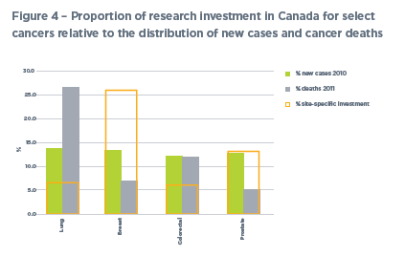
Just looking at the above, it is evident that there is a large gap in funding. This means researchers in the breast group are able to fund, publish, and present more research. One should also ask if there is a disparity within each disease group. Is there research being screen-shot-2016-12-17-at-6-23-41-amdone on metastatic patients, or patients who are outliers? I imagine they feel neglected too. In the U.S., part of this problem may have just been addressed with the signing of the 21st Centuries Cures Act. The rest of the world however  may not have a course correction, so we need to be able to recognize that in order to have equality, we need to point out the inequities. Then instead of cutting the pie smaller, we need to bake a bigger pie. We need to break down barriers, and share information. More and more we see that the driving mutations in different disease groups are the same.

  • Access to patient resources is different – As a patient trying to access a support group or assistance with services, I can tell you there is very little out there for patients with some cancers or diseases, where as there can be a glut for others. Even as a young adult with cancer it is difficult to access the services needed to cope with a cancer diagnosis and the reprucussions of treatments. The advent of online groups and social media is wonderful because people can connect, but groups can often be hard to find or “word of mouth” where as I can almost guarantee there will be a breast or lymphoma group in every centre. Again, the comparisson is made to illustrate the inequity, not to spur on competition.
  • Perception is different – I can attest to the stigma of having lung cancer. Any and almost every time I inform someone that I have lung cancer, the first thing I am asked is whether I was a smoker. I have also had people let me know about services they provide in the cancer centre when I am wearing my pink scarf, only to tell me how unlucky I was not to actually have breast cancer (I swear this happened) once informed I had lung. The truth is, most people assume if you got lung cancer, you must have gotten it from smoking. This illustrates the need for the lung cancer community to educate the public (and some medical personnel) that there are many risk factors to getting lung cancer (Radon, genetics, the environment, having lungs, smoking, unknown factors), and that smoking is a risk factor for many diseases, like heart disease, tooth decay, oral cancers, COPD, etc. The truth is, there is a stigma attached to having some cancers. Let’s get it straight, NO ONE DESERVES CANCER!!!!
  • Cancer is not one disease – The word cancer represents about 100 different diseases, and each one varies with the individual it effects. We are just now learning what drives some cancers, but there is so much that isn’t known. How can anyone possibly say all cancer is the same, no it isn’t. Not in the way it is diagnosed, staged, treated, maintained, long term side effects, recurrance rates, mortality, etc. What is the same is how profoundly it effects every single person it touches.

That is why I’m pissed off. They totally ignored all of those things and made it look like we can be catty children comparing ourselves for some sympathy prize, well I’m calling bullshit.

Cancer patients, at least the ones I know, and I know a few, young and old, from all over the planet are so far from this picture they paint that if they saw this article I think they’d either be hurt, apalled, or laugh because they are the most intelligent, compassionate, generous, kind, interesting people I have ever had the privilege of meeting. They have been through upheaval; poisoning (through radiation or chemo); some have been ripped open; they have gone through therapy (physical or psychological); have gone back to work; to school; retired; have traveled; become advocates and educators; become researchers; become parents (grand parents); become husbands or wives; recurred; and some sadly have passed on. So please give us more credit that calling us rivals.

Rather than write a bait-click article, do a little digging and write about the issues.

AM

*Figure 3 & 4 taken from Lung Cancer Canada, Faces of Lung Cancer Report: Research and Analysis of the Lung Cancer “Waiting Game”, 2016


Stability ain’t what its cracked up to be!

This is my favorite time of year. I don’t know what it is about the weeks leading up to the holidays, but I just love them. My heart is warmed by twinkling lights adorning all the neighborhood houses and people seem just a little bit more cheerful. Just the other day it snowed, not just a dusting either, a real good snow. It was magnificent. Looking out our windows Sunday night and seeing a fluffy white blanket covering everything made me giddy. Everything seemed magical and pristine.

That day I spent the day in my jammies watching movies with the pups and a good cup of tea, it was heaven! A stark contrast to the hustle and bustle of the week before. It was a scan/check-in week preceded by a very long scare & scan day the previous Friday. Needless to say I had an x-ray, two chest CTs (one abdominal and pelvic), an MRI, an ECG an ECHO as well as blood work (thank you port) all in the span of 5 days and my body was feeling a little worse for wear. Thankfully, the scare turned out to be a chest infection and nothing more. Amidst all that my scans still say stable.

img_4782
Blargh!!

I am learning to live with stable, even though I don’t like it, even though I’d feel so much more secure if I was NED. NED allowed me imagine no cancer in my body, whether it was true or not, I don’t know. Its hard and sometimes torturous knowing that inside you there is a ticking time bomb or in my case many little time bombs just waiting to grow and spread (and kill you). The uncertainty makes it easy to go down the rabbit hole so much so that the thoughts permeate into everything, even my seasonal happiness.

While trimming the tree, I caught myself thinking… Wow! This is our first Christmas in this house, how truly amazing. I wonder if it will be my last? I wonder how many more Christmases I’ll get? I wonder if Patrick will decorate like this after I’m gone?

You see how easy it can be to get sucked in.

I don’t know if it is because I live my life in three week increments or six week milestones, but looking at a full year is truly daunting and scary. I felt the same way planning my wedding. It felt like a mixture of joy and sheer terror! Life can change so quickly. I have seen it happen too many times.

And then I remember to breathe.

Despite all these crazy emotions and being sick (my lungs sound like bagpipes warming up), my soul is happy. I find myself sitting on my couch sometimes, and I look around, and I am awed and I am grateful for all the blessings I have in my life. My husband, my family, my friends, my dogs, my home, and my health. My life is so rich! That is what I need to hold on to. That is the light that guides me out of the rabbit hole.


AM


The New Face of Lung Cancer

Receiving a cancer diagnosis is devastating and life altering, but as a young adult with lung cancer the challenge was even more daunting. Like most people I was oblivious that I could get lung cancer, after all as a young woman I thought I was more likely to get breast cancer because I had breasts. I never fathomed that because I had lungs I could get lung cancer2013-08-14-20-48-46. I know differently now.

Even after beating the odds of living 5 years beyond diagnosis, the first question I’m asked when people find out I am living with lung cancer is “did you smoke?” The idea that smoking causes lung cancer is so entrenched in our psyche that most people have no idea that up to 60%1 of lung cancer patients have either never smoked a day in their lives, or quit decades prior to their diagnosis resulting in an unfair stigma being placed on patients and their families.* The notion that someone deserves their disease is a ridiculous concept to me, but a 2010 national poll showed more than one in five Canadians said they feel less sympathy for people with lung cancer than those with other cancers because of its link to smoking2.

I started down this road in 2009 when a small bump on my collarbone sent me to my doctor. Despite being unconcerned he sent me for an x-ray. That simple action would lead to the cascade of tests that would ultimately lead to the diagnosis of locally advanced adenocarcinoma of the lung. I am lucky! Things could have gone differently, I could have been inoperable, I could have been sent home, I could have been ignored, I have many friends who were, they didn’t get diagnosed until they were very sick, and sometimes even too late.

Once I peiced the tatters of my life back together, recurrence hit. I was devastated once again. My worst fears had come to pass. Beating Lung Cancer once was hard, I knew beating it twice would be damn near impossible, after all, at 17%, the five-year survival rate for lung cancer remains one of the lowest of all the major cancers3.

Finding out that I was a mutant was a relief…I know what you are thinking?? What! I’m sure most people would opt for a super power, but knowing I had an ALK-EML4 fusion meant I had options, so for me it was just as good. Prior to this revelation, I had few to no options left as a 32 year old stage 4 recurrent lung cancer patient. I was literally waiting to get sick so I could get treated and hope it wasn’t too late knowing full well I’d likely become one of the 85% of lung cancer patients. Dead.

I found information about a targeted therapy in clinical trial in a blog, much like this one. At the time I didn’t know anything about trials, targeted therapies, or driver mutations but I immediately jumped on this and looked for any way I could get in to the trial. Luckily there was a trial close to my home. In Sept. 2011 I was admitted and randomized to the drug group and began taking an ALK inhibitor. From that time until July of this year I had been NED (No Evidence of Disease, the best letters of the alphabet) and being unrmarkable was fantastic, but things change. I have always known that change would come, cancer is cunning and insidious.

Fear not dear reader, I am in a new trial for a third generarion targeted therapy. Targeted therapies mean I can live a fairly normal life. I don’t have to worry about neutropenia and infection, or other damaging side effects. I am able to live and travel. I am able to advocate and volunteer. I am able to plan a wedding, buy a house and plan on a long life ahead. It isn’t a cure, I will likely never be cured, but I gladly put my faith in research, after all it has given me five years and counting.

What’s disturbing is that every year, 26,100 Canadians will be diagnosed with lung cancer, 20,800 of those diagnosed will die4. It takes the lives of more Canadians than breast (5,000 lives), prostate (4,000 lives) and colorectal cancers (9,300 lives) combined5. Yet it is one of the most underfunded.

It is exciting times in lung cancer research and diagnosis. Less invasive procedures, genetic testing, screening procedures, and many new targeted therapies are being developed and improved upon and patients are benefitting in so many ways. From prolonged life and higher quality of life to the freedom of taking their treatment at home and living life unremarkable or not to the fullest. You may think, great! They don’t need funding or support, but in actuality, the disease receives only 7 per cent of cancer-specific government research funding and less than one per cent of private cancer donations6. I can only imagine what they could do with 3%.

Living with a chronic disease, isn’t about how many days we have to live, it’s the ability to live life in the days we have. When it is my time to leave this earth, I will do so having no regrets. I will know that I did not let my diagnosis define me but allowed me to be the person I was meant to be.

AM

*Current smokers had smoked 100 or more cigarettes and currently smoked. Current non-daily smokers were current smokers who smoked only on some days. Former smokers had smoked 100 or more cigarettes and no longer smoked at all7.

  1. Lung Cancer Canada, Lung Cancer Accessed at: http://www.lungcancercanada.ca/Lung-Cancer.aspx
  2. Ipsos MORI, Perceptions of Lung Cancer in Canada, An Ipsos MORI report for the Global Lung Cancer Coalition, April 2010. Accessed at: http://www.lungcancercanada.ca/ resources/site1/general/PDF/CanadaReport.pdf
  3. Canadian Cancer Society, Canadian Cancer Statistics 2016, p. 64
  4. Canadian Cancer Society, Canadian Cancer Statistics 2016, p. 50
  5. Canadian Cancer Society, Canadian Cancer Statistics 2016, p. 50
  6. Canadian Cancer Research Alliance 2007, CRA 2009, Canadian Cancer Society 2010.
  7. Husten, C. G. (2009) How should we define light or intermittent smoking? Does it matter? Nicotine Tobacco Research 11(2), 111-121.