
Its snowing again and I can’t sleep.
Maybe its because I can’t stop thinking about an article I saw online. Even the openning lines seem to fan the fires of competition, when in most cases there isn’t any. My knee jerk reaction is that this is lazy writing. It builds conflict between disease groups by providing “sound bite” comments as proof and then complete ignores the issues faced by patients.
Let me begin by saying, I think all cancer is awful and never once have compared myself to my peers whether in the lung cancer world, young adult world, or in the cancer world at large. I have lost too many friends to count from every type of cancer, perotid gland, ovarian, adrenal gland, oglidendroma, etc., so I really try not to discriminate.
Articles like the one above piss me off because they skirt the issues, so let me make them clear and plain for all to see.
-

NIH funding Not all cancers are funded equally – That means funding for research and publication of said research is laking in many cancer groups. When we compare disease groups in this sense, we are merely trying to state the disparity. For purpose of this arguement, I will compare lung cancer funding to breast, and prostate cancers. The facts are that for every patient who died form their respective disease, a lung cancer patient “received” $1479 in research funds, a breast cancer patient “received” $19250, and a prostate cancer patient “recieved” $9432, I don’t imagine those numbers have changed much *since 2012.
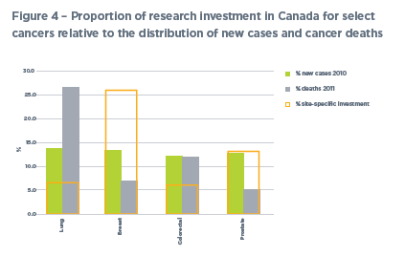
Just looking at the above, it is evident that there is a large gap in funding. This means researchers in the breast group are able to fund, publish, and present more research. One should also ask if there is a disparity within each disease group. Is there research being  done on metastatic patients, or patients who are outliers? I imagine they feel neglected too. In the U.S., part of this problem may have just been addressed with the signing of the 21st Centuries Cures Act. The rest of the world however may not have a course correction, so we need to be able to recognize that in order to have equality, we need to point out the inequities. Then instead of cutting the pie smaller, we need to bake a bigger pie. We need to break down barriers, and share information. More and more we see that the driving mutations in different disease groups are the same.
- Access to patient resources is different – As a patient trying to access a support group or assistance with services, I can tell you there is very little out there for patients with some cancers or diseases, where as there can be a glut for others. Even as a young adult with cancer it is difficult to access the services needed to cope with a cancer diagnosis and the reprucussions of treatments. The advent of online groups and social media is wonderful because people can connect, but groups can often be hard to find or “word of mouth” where as I can almost guarantee there will be a breast or lymphoma group in every centre. Again, the comparisson is made to illustrate the inequity, not to spur on competition.
- Perception is different – I can attest to the stigma of having lung cancer. Any and almost every time I inform someone that I have lung cancer, the first thing I am asked is whether I was a smoker. I have also had people let me know about services they provide in the cancer centre when I am wearing my pink scarf, only to tell me how unlucky I was not to actually have breast cancer (I swear this happened) once informed I had lung. The truth is, most people assume if you got lung cancer, you must have gotten it from smoking. This illustrates the need for the lung cancer community to educate the public (and some medical personnel) that there are many risk factors to getting lung cancer (Radon, genetics, the environment, having lungs, smoking, unknown factors), and that smoking is a risk factor for many diseases, like heart disease, tooth decay, oral cancers, COPD, etc. The truth is, there is a stigma attached to having some cancers. Let’s get it straight, NO ONE DESERVES CANCER!!!!
- Cancer is not one disease – The word cancer represents about 100 different diseases, and each one varies with the individual it effects. We are just now learning what drives some cancers, but there is so much that isn’t known. How can anyone possibly say all cancer is the same, no it isn’t. Not in the way it is diagnosed, staged, treated, maintained, long term side effects, recurrance rates, mortality, etc. What is the same is how profoundly it effects every single person it touches.
That is why I’m pissed off. They totally ignored all of those things and made it look like we can be catty children comparing ourselves for some sympathy prize, well I’m calling bullshit.
Cancer patients, at least the ones I know, and I know a few, young and old, from all over the planet are so far from this picture they paint that if they saw this article I think they’d either be hurt, apalled, or laugh because they are the most intelligent, compassionate, generous, kind, interesting people I have ever had the privilege of meeting. They have been through upheaval; poisoning (through radiation or chemo); some have been ripped open; they have gone through therapy (physical or psychological); have gone back to work; to school; retired; have traveled; become advocates and educators; become researchers; become parents (grand parents); become husbands or wives; recurred; and some sadly have passed on. So please give us more credit that calling us rivals.
Rather than write a bait-click article, do a little digging and write about the issues.
AM
*Figure 3 & 4 taken from Lung Cancer Canada, Faces of Lung Cancer Report: Research and Analysis of the Lung Cancer “Waiting Game”, 2016


 Every year 28,4001 Canadians and 221,2002 Americans are diagnosed with lung cancer. Of those diagnosed, 20,8003 in Canada and 157,4994 in the US will have their lives taken from this disease. The truth is that while many other cancers have improved 5-year survival rates, lung cancer still remains one of the lowest at about 17%5.
 If one has asked me what type of cancer I thought I may get in my lifetime, seven years ago before lung cancer happened to me, I would have thought it would be breast cancer. After all, I am a woman with breasts and like many, I didn’t think that because I was human and had lungs that I’d be at risk. The reality is, one of the fastest growing segments in lung cancer is the population of young, non/never smokers (17.9%)7. Add to that the population of people who had previously quit smoking (60%)8, and you begin to get a different picture of lung cancer.

 . I know differently now.


 Life is hard enough under normal circumstances, but you get thrown into the lion’s den when you are diagnosed with cancer. Its something that changes you forever, whether you want it to or not. The diagnosis and the fallout usurp every fiber of who you are before cancer. If you are lucky, you get cured, but you can’t forget. Some of us are able to shake it off or move on and become survivors. I am not one of them.
 These Are My Scars
You must be logged in to post a comment.