Magic Happens

Something magic happens when you gather lung cancer patients together!

On the evening of Thursday November 17th Lung Cancer Canada hosted their annual Evening of Hope Gala. What was different this year was that our Gala would kick off our first Hope is Here Patient Summit.

We welcomed Canadians from all over the country to the first ever lung cancer patient summit for a one-day conference held at the Sheraton Centre in downtown Toronto. The Summit featured educational break-out sessions, inspirational speakers (including myself and other patients), and the opportunity to connect with people from all over Canada who have had a lung cancer diagnosis.

The day was opened by our President Dr. Wheatley-Price. I followed him in welcoming our guests by sharing a bit about my story and all the breakthroughs in treatments and diagnostics that have been approved and are in practice since I was diagnosed in 2009. Our  morning program began with New Advances in Lung Cancer and covered a number of topics: Screening and Surgery; Radiation Therapy; Immunotherapy and Targeted Therapies; Future Direction of Lung Cancer; and a question session moderated by Dr. Wheatley-Price.

Dr. Gail Darling gave us a comprehensive overview of the roll-out for Ontario’s Early Screening Lung Cancer Program for high risk populations. This is fantastic news because all the research surrounding early detection programs is very positive. The NIH’s National Lung Screening Trial (NLST) 2011, showed a 20% decrease in mortality in the screened group. That may not seem like much, but consider that for the same number of breast cancer patients screened there is only a 3 to 4% decrease in mortality. They showed that the number of lung cancer patients needed to screen to save one life is 320. For colon cancer the number is 600 and for breast it is 1000, proving early screening for this targeted population is truly effective and does indeed save lives.

Radiologist Dr. David Palma provided a very passionate presentation about radiation in populations that may have previously been denyed an opportunity to have radiation as a viable option after metastasis. He also championed the idea that in order for patients to be partners in their care and recieve the best care, they need to know how to advocate for themselves, decipher reports and how to compare their care against published guidelines.

Dr. Rosalyn Juergens gave us the low-down on Immunotherapy and Targeted Therapies. A very informative session illustrating complexity of lung cancer and the variety of new therapies designed to treat them. She discussed the numerous targeted therapies available for both EGFR and ALK, but now also for ROS1 and other driver mutations. Immunotherapy is another area where a number of agents are being tested and approved for use in patients with great success and lasting effects. Finally, there is hope for lung cancer patients.

With our brains and notepads full, it was time for a break and a bit of socializing. Following the break, we continued with the McAlpine’s who shared their story with us. The crowd was brought to tears as Ian and his wife Cathy shared the ups and downs of accessing treatment. To my amazement, I realised that I had seen them many times and that we had shared a doctor. Their tenacity brought them from British Columbia to Ontario to get care, and I am so happy that the journey has been successful.

My former oncologist Dr. Jeffrey Rothenstein gave his presentation about participating in and accessing clinical trials. According to his presentation, only 3 out o f 100 patients take part in clinical trials and even fewer lung cancer patients participate. What is mindboggling is that 85% of patients aren’t aware that clinical trials are viable treatment options. I can attest that clinical trials save lives! I literally wouldn’t be alive today if it weren’t for that option.

My current oncologist Dr. Natasha Leighl presented her perspective on treatment access and cost. What was great about this presentation was that it wasn’t just literal cost of medications that was discussed, but the toll on the family, inequality of access, and a number of other factors that affect patients after a diagnosis of lung cancer. I had no idea that Canada was second behind the U.S. in out of pocket drug costs, and that 91% of cancer patients will suffer from financial toxicity. She also highlighted the fact that Canada is much slower than other countries when it comes to drug approval and funding. This was a focus of Lung Cancer Canada this year in their 2016 edition of Faces of Lung Cancer.

Before we dispersed for lunch, my friend and our Vice President Casey Cosgrove discussed advocacy and community involvement. Illustrating both the need for volunteers and advocates and ways to help. I loved his point that not everyone is good at or wants to do everything, but if we do what we’re are comfortable with, we can help in our own way.

During our lunch break, our keynote speaker Darrell Fox spoke to us about his older brother Terry, and the legacies Terry Fox left behind. The Terry Fox Foundation which has raised over 700 million dollars since Terry’s death in 1981 and the Terry Fox Research Institute. The TFRI is funding the Pan-Canadian Early Lung Cancer Detection Study. Darrell also shared his father Roland’s story. Rollie as he was known passed away this year from lung cancer making the Fox family a part of our community. It was a truly emotional speech and not many of us had a dry eye.

The remainder of the day consisted of breakout sessions that included sessions in nutrition, breathing and exercise, financial planning and palliative care. Each session was very informative. The nutrition session provided ideas and tips to quick healthy meals that cater to health and healing. The exercise and breathing session demonstrated activities that one could do at home and that could be adapted to differing abilities. The session was sponsored by Wellspring who hosts a 20 week exercise program for patients. The financial planning session provided tips to help plan while ill, or to prepare incase of death. Finally, the session on palliative care discussed the variety of options and that palliative care isn’t just about dying.

After regrouping it was time to close the day with a photo and good-byes.

img_4746It is impossible to describe the feeling when you meet someone else like you.Therefore unimaginable when you meet 60. All I can say is my heart was full and I am so privileged to be a part of such a wonderful event. This was Lung Cancer Canada’s first Hope Is Here Patient Summits, I know it won’t be the last. I thank everyone in the office and all the volunteers and sponsors for everything you did!

AM



A Breath of Fresh Air

We must accept finite disappointment but never lose infinite hope.

-Martin Luther King Jr.screen-shot-2016-11-12-at-4-46-08-pm

For a very long time, lung cancer research had languished and little improvement occurred in treatments and patient care. Most required chemo, radiation, or invasive surgery, or perhaps a combination of all three. Despite these interventions, many patients died. It was a pretty hopeless time.

As recent as 7 years ago, targeted treatments were mostly theoretical, and immunotherapy a pipe dream. Today, both are realities and saving lives. The winds of change are blowing and hope is in the air.

I can tell you what it feels like to come to terms with a terminal illness, how difficult it is to wrap your head around dying before you are 35. I can tell you what it feels like to be written off because there really isn’t anything out there that will really help. But, I can also tell you about hope. Hope saved my life.

In the 7 years since I was diagnosed and 5 years since I was deemed “terminal” so much has happened in lung cancer research. In those days, physicians only really knew about two potential genetic drivers, now we know of 25 and learning of more everyday. In that time, pharmaceutical companies have developed targeted kinase inhibitors (TKIs) that target specific genetic anomalies or fusions such as EGFR, ALK, and ROS1 and testing others like MEK, KRAS and Her2. These compounds are better known as targeted therapies and are far more effective in treating patients with these targets than chemo. In many cases, these treatments are pills that one takes daily, they have milder side effects than chemo and can allow patients to live a fairly normal life. We have come so far in this area that second and even third generation drugs are being developed to address resistance to earlier drug compounds.

Another area that has revolutionized treatment is immunotherapy. Just in the last few years the FDA approved two immunotherapy agents for both non-squamous cell lung cancer and squamous cell lung cancer. These agents boost the use the body’s own immune system to target and kill cancer cells. For the first time in many years there is real hope for patients that have squamous cell lung cancer one of the most aggressive and deadly types of lung cancer.

In addition to new treatment options, and the discovery of numerous genetic drivers of lung cancer, diagnostic techniques and surgical interventions have become better and less invasive for patients. The use of computerized tomography (CT scans) and positron emission tomography (PET scans) allow physicians to see anomalies at earlier stages and allow for more accurate diagnoses. In addition to this, screening of high-risk populations using low dose CTs allows physicians to follow these patients and diagnose them at earlier stages of the disease, increasing survivorship and quality of life. Not only does this save lives, but it also saves money as these patients require less intervention and can be cured when diagnosed at stage 1 or 2, where surgery alone is curative. Video-assisted thoracoscopic surgery or VATS allows patients to undergo surgery, most often a lobectomy (removal of one or more lobes of the lung) with minimal invasion and less risk of complications from surgery, making recovery quicker and easier on the patient and their caregivers.

All these breakthroughs have been achieved despite minimal research funding allocation by governments and private donors. Regardless, patients have a real reason to hope as the dedication of researchers and physicians who are making these discoveries are ushering in a new era in lung cancer research and treatment. One can only imagine the possibilities if there was even small increase in the amount of funding given to this disease group. One can always hope.

screen-shot-2016-11-12-at-4-48-37-pm

The Need for Lung Cancer Literacy

November 1st marked lung cancer awareness month in Canada and the US. It received little fan-fare and still largely goes un-noticed. After all we don’t have cute logos, fancy ribbons, big marketing campaigns, and many media outlets just don’t pick up the lung cancer story. So what do we have? We have numbers, we have stigma, and we have hope.

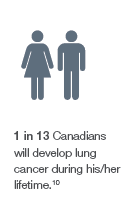
screen-shot-2016-11-04-at-8-16-07-pmEvery year 28,4001 Canadians and 221,2002 Americans are diagnosed with lung cancer. Of those diagnosed, 20,8003 in Canada and 157,4994 in the US will have their lives taken from this disease. The truth is that while many other cancers have improved 5-year survival rates, lung cancer still remains one of the lowest at about 17%5.

One of the many reasons for this in my humble opinion is the lack of lung cancer literacy, or for lack of better words awareness. With most diseases, awareness doesn’t always mean action, but for us, awareness and education is key in convincing people to act. Most North Americans think that breast cancer is the largest cancer killer, but in fact, it is lung cancer. Actually, lung cancer takes more lives than breast, colorectal, and prostate cancers combined6.

screen-shot-2016-11-04-at-8-16-44-pmIf one has asked me what type of cancer I thought I may get in my lifetime, seven years ago before lung cancer happened to me, I would have thought it would be breast cancer. After all, I am a woman with breasts and like many, I didn’t think that because I was human and had lungs that I’d be at risk. The reality is, one of the fastest growing segments in lung cancer is the population of young, non/never smokers (17.9%)7. Add to that the population of people who had previously quit smoking (60%)8, and you begin to get a different picture of lung cancer.


The sad truth is that lung cancer is usually diagnosed in late stages (Stage 3 and 4) meaning the disease is already advanced, complicated and difficult to treat. Another reality faced by patients and their caregivers is the stigma associated with the disease. We have known the connection between tobacco products and cancer for decades, the problem is the widespread assumption that it is the only cause of lung cancer, leading to a blame the victim mentality. The truth is, the greatest risk factor for getting lung cancer is having lungs. That of course is followed by tobacco, radon, genetic and many unknown factors.

Lung cancer is not just one disease, it is far more complicated than was once thought. It is categorized as small cell (SCLC) or non-small cell (NSCLC), but can then further be divided by cell type and beyond. In the past decade alone, they have discovered numerous genetic drivers to lung cancer, each requiring a treatment plan that caters to the nature of the cancer.

Despite the abysmal mortality rate and the growing number of newly diagnosed patients, funding for lung cancer research is grossly disproportionate. In the US the National Institute of Health Research (NIH) calculated the dollars allocated per death across many disease areas and found that lung cancer received only $1479 as compared to $2131 for heart disease, $5,804 for colon cancer, $19,250 for breast, and $9,647 for all cancers9. In Canada, only 7% of cancer specific government research funding is allocated to lung cancer but what is worse is less than 1% of private cancer donations goes towards lung cancer research10.

It may sound very doom and gloom, but there are many rays of hope. Through the dedication of researchers, oncologists, nurses, pathologists, patients, and so many more, a number of breakthroughs have been made in diagnostics, less invasive surgical options, revolutionary treatments such as targeted therapies and immunotherapy and are being used in clinics today. The winds of change are blowing and with more awareness and research dollars, real change can be made. You can help by donating to lung cancer research, volunteering at a local organization, being compassionate to patients, or by sharing this article.

References:

1. Canadian Cancer Society – 2016 Canadian Cancer Statistics. Available at: http://www.cancer.ca/~/media/cancer. ca/CW/cancer information/cancer 101/Canadian cancer statistics/Canadian-Cancer-Statistics-2016-EN.pdf?la=en. Last accessed on October 19, 2016.

2. American Cancer Society. Cancer Facts & Figures 2015. Atlanta: American Cancer Society; 2015. pp.4.

3. Canadian Cancer Society – 2016 Canadian Cancer Statistics. Available at: http://www.cancer.ca/~/media/cancer. ca/CW/cancer information/cancer 101/Canadian cancer statistics/Canadian-Cancer-Statistics-2016-EN.pdf?la=en. Last accessed on October 19, 2016.

4. Centers for Disease Control and Detection: Deaths: National Vital Statistics Report, Final Data for 2012. NVSR Volume 63, Number 9. 85 pp. (PHS) 2014 – 1120, http://www.cdc.gov/nchs/data/nvsr63/nvsr63_09.pdf

5. Lung Cancer Canada. 2015 Faces of Lung Cancer Report, Toronto: Lung Cancer Canada, 2015. pp6.

6. Lung Cancer Canada. 2015Faces of Lung Cancer Report, Toronto: Lung Cancer Canada, 2015. pp6.

7. Centers for Disease and Prevention. Morbidity and Mortality Weekly Report, “Cigarette Smoking Among Adults- United States. 2006,” November 9, 2007/56(44): 1157-1161, Table 2.

8. Centers for Disease and Prevention. Morbidity and Mortality Weekly Report, “Cigarette Smoking Among Adults- United States. 2006,” November 9, 2007/56(44): 1157-1161, Table 2.

9. Funding Source: http://report.nih.gov/categorical_spending.aspx Source of Actual Deaths: Centers for Disease Control and Detection: Deaths: National Vital Statistics Reports, Final Data for 2012. NVSR Volume 63, Number 9. 85pp. (PHS) 2014 – 1120 http://www.cdc.gov/nchs/data/nvsr/nvsr63/nvsr63-09.pdf

10. Canadian Cancer Research Alliance 2007, CRA 2009, Canadian Cancer Society 2010.

The New Face of Lung Cancer

Receiving a cancer diagnosis is devastating and life altering, but as a young adult with lung cancer the challenge was even more daunting. Like most people I was oblivious that I could get lung cancer, after all as a young woman I thought I was more likely to get breast cancer because I had breasts. I never fathomed that because I had lungs I could get lung cancer2013-08-14-20-48-46. I know differently now.

Even after beating the odds of living 5 years beyond diagnosis, the first question I’m asked when people find out I am living with lung cancer is “did you smoke?” The idea that smoking causes lung cancer is so entrenched in our psyche that most people have no idea that up to 60%1 of lung cancer patients have either never smoked a day in their lives, or quit decades prior to their diagnosis resulting in an unfair stigma being placed on patients and their families.* The notion that someone deserves their disease is a ridiculous concept to me, but a 2010 national poll showed more than one in five Canadians said they feel less sympathy for people with lung cancer than those with other cancers because of its link to smoking2.

I started down this road in 2009 when a small bump on my collarbone sent me to my doctor. Despite being unconcerned he sent me for an x-ray. That simple action would lead to the cascade of tests that would ultimately lead to the diagnosis of locally advanced adenocarcinoma of the lung. I am lucky! Things could have gone differently, I could have been inoperable, I could have been sent home, I could have been ignored, I have many friends who were, they didn’t get diagnosed until they were very sick, and sometimes even too late.

Once I peiced the tatters of my life back together, recurrence hit. I was devastated once again. My worst fears had come to pass. Beating Lung Cancer once was hard, I knew beating it twice would be damn near impossible, after all, at 17%, the five-year survival rate for lung cancer remains one of the lowest of all the major cancers3.

Finding out that I was a mutant was a relief…I know what you are thinking?? What! I’m sure most people would opt for a super power, but knowing I had an ALK-EML4 fusion meant I had options, so for me it was just as good. Prior to this revelation, I had few to no options left as a 32 year old stage 4 recurrent lung cancer patient. I was literally waiting to get sick so I could get treated and hope it wasn’t too late knowing full well I’d likely become one of the 85% of lung cancer patients. Dead.

I found information about a targeted therapy in clinical trial in a blog, much like this one. At the time I didn’t know anything about trials, targeted therapies, or driver mutations but I immediately jumped on this and looked for any way I could get in to the trial. Luckily there was a trial close to my home. In Sept. 2011 I was admitted and randomized to the drug group and began taking an ALK inhibitor. From that time until July of this year I had been NED (No Evidence of Disease, the best letters of the alphabet) and being unrmarkable was fantastic, but things change. I have always known that change would come, cancer is cunning and insidious.

Fear not dear reader, I am in a new trial for a third generarion targeted therapy. Targeted therapies mean I can live a fairly normal life. I don’t have to worry about neutropenia and infection, or other damaging side effects. I am able to live and travel. I am able to advocate and volunteer. I am able to plan a wedding, buy a house and plan on a long life ahead. It isn’t a cure, I will likely never be cured, but I gladly put my faith in research, after all it has given me five years and counting.

What’s disturbing is that every year, 26,100 Canadians will be diagnosed with lung cancer, 20,800 of those diagnosed will die4. It takes the lives of more Canadians than breast (5,000 lives), prostate (4,000 lives) and colorectal cancers (9,300 lives) combined5. Yet it is one of the most underfunded.

It is exciting times in lung cancer research and diagnosis. Less invasive procedures, genetic testing, screening procedures, and many new targeted therapies are being developed and improved upon and patients are benefitting in so many ways. From prolonged life and higher quality of life to the freedom of taking their treatment at home and living life unremarkable or not to the fullest. You may think, great! They don’t need funding or support, but in actuality, the disease receives only 7 per cent of cancer-specific government research funding and less than one per cent of private cancer donations6. I can only imagine what they could do with 3%.

Living with a chronic disease, isn’t about how many days we have to live, it’s the ability to live life in the days we have. When it is my time to leave this earth, I will do so having no regrets. I will know that I did not let my diagnosis define me but allowed me to be the person I was meant to be.

AM

*Current smokers had smoked 100 or more cigarettes and currently smoked. Current non-daily smokers were current smokers who smoked only on some days. Former smokers had smoked 100 or more cigarettes and no longer smoked at all7.

  1. Lung Cancer Canada, Lung Cancer Accessed at: http://www.lungcancercanada.ca/Lung-Cancer.aspx
  2. Ipsos MORI, Perceptions of Lung Cancer in Canada, An Ipsos MORI report for the Global Lung Cancer Coalition, April 2010. Accessed at: http://www.lungcancercanada.ca/ resources/site1/general/PDF/CanadaReport.pdf
  3. Canadian Cancer Society, Canadian Cancer Statistics 2016, p. 64
  4. Canadian Cancer Society, Canadian Cancer Statistics 2016, p. 50
  5. Canadian Cancer Society, Canadian Cancer Statistics 2016, p. 50
  6. Canadian Cancer Research Alliance 2007, CRA 2009, Canadian Cancer Society 2010.
  7. Husten, C. G. (2009) How should we define light or intermittent smoking? Does it matter? Nicotine Tobacco Research 11(2), 111-121.


Its #LCAM

Please excuse the late post! I was truly hoping to have this post up earlier, much earlier infact, but today was one of those crazy days where life goes topsy turvy. Now before I get to that, I wanted to share a few Halloween pictures since this was our first in our new home. After prepaing for a barrage of kiddos, we ended up only getting about 20, so leftovers abound as evidenced by some of the pictures.

Okay now back to the crazy day! It was November 1st yesterday marking the beginning of Lung Cancer Awareness Month. Usually I am busy attending or participating in Lung Cancer Canada’s press conference where they present our Faces of Lung Cancer Report that details the current status of lung cancer in Canada, however this year it was held in our Nation’s Capitol, Ottawa. I made the choice to stay home in Toronto as I had a project of my own that I wanted to launch. Since I hadn’t gotten a good sleep the night before (hello 7am sleepy time) I was just getting up, when I got a call to see if I was available to do an interview. Of course I said yes! Anything to help raise awareness!!

So up I got and scrambled to get my self and the house ready incase they came here. Needless to say, I just had enough time to shower and meet with the interviewer. The topic of the interview was the rising incedence of lung cancer in women and lung cancer as a women’s health issue. Now far be it from me to tell the media that they missed the ball on that one (It was one of the main topics of the first Faces of Lung Cancer Report), but I answered as best as I could. It went well and I went home and set the PVR. Here is the link. If I had a wee bit more time, I know I could have avoided all the ums and ahs.

When all was said and done, I got to work on my #LCAM project. Some may or may not have noticed a new menu button on my home page, but one has been added and it links to my new storefront (Hope Happens). If you click it, you will find handmade jewelry made by yours truly. It is symbolic of the hope I have for myself and for others who have been diagnosed. All the jewelry features pearls as pearl is the colour for lung cancer. It is my hope that I can raise $21,000 by next year at this time for the almost 21000 Canadians who will die from this disease in 2016. So please take a look and help me to support research and programs for patients and their families.

AM


Scanxiety and my irrational mind

I sit here on this gloomy day waiting for all my appointments to be over. I have been here since 8 am, it’s now quarter to 5 and I’m still here. It has been an unsatisfactory day. I was hoping for the results of my last CT, I’m here to do an MRI, the anticipation is killing me. Outwardly I am calm, cool, and collected, but I’m good at hiding my anxiety. Ask anyone close to me and they will tell you they had no idea I was worried, but I have been hoping for an NED for a while now. I’m still waiting and I’m worried.

I thought I’d be a super responder like I had been on Crizotinib. I was NED within 6 weeks, until I progressed almost 5 years later. The bar was set impossibly high. I’m on cycle 6 of Lorlatinib and I’m impatiently waiting for what may never come. Don’t get me wrong, I am responding, things are shrinking. I am happy about that, where my disappointment lays is in the fact that things are still present or at least they have been.

I got used to clean scans and the complacency they brought. I got lulled into a false sense of security. I took comfort in being unremarkable. I can tell you I am no longer complacent or secure. I am in fact very very insecure. 

I need to say I don’t do well with uncertainty. I am a confessed Type-A so me and uncertainty don’t like to dance, and lately we’ve been dancing far too often and uncertainty has been stepping on my feet. 

In my rational mind I tell myself, “Self things are going very well, they are moving in the right direction, be happy. Remember, you can’t control anything except the way you react. Be happy.” My rational mind is wise, my problem is my irrational mind is what’s been talking to me lately and that conversation doesn’t go as well!

My irrational mind is full of fear and brings me to all sorts of dark and worrying places. Places I don’t want to think about when I’m dealing with the unknown. It reminds me of the first time I felt this way, way back in 2011 when I wasn’t sure my cancer had come back. I had to know. Knowing meant I could gear myself up for a fight, or to deal with sadness/anger/relief, but not knowing. Not knowing was torture! 

Back then I was terrified that I would have a recurrence. It was the worst possible thing that could happen, or so I thought. Then it happened. I realized it wasn’t the end of the world. It changed things, a lot of things, but my world didn’t end. Actually it allowed me to realize and accept that my life would always be different. That was a good thing. Now I feel different. The stakes are higher. I’m not affraid of recurrence, recurrence is my reality, what I’m affraid of is running out of options and running out of time. NED means so much more now that it isn’t just me. 

NED means I get to garden in the spring. It means I get to keep coming home to two ecstatic dogs and a loving husband. NED mean I can keep advocating. It means I can appreciate growing older, my gray hairs and wrinkles. NED means I get exponentially more moments of small joys. That’s all I want. Until then, I will be a bundle of nerves. I will have an ache in my stomach and knots in my back. I will feel the elephant on my chest. I will try to breathe, I will try to remain calm, but until I read NED on my reports, nothing will quell my anxiety.

AM

Links are live

Another bout of insomnia had provided me with the impetus to get a links page going. I have put together a short list of the resources I have used. All the sites are excellent with the exception of the impossible to navigate Health Canada page. Please check it out and pass it along to any one who may need it. All sites used there are vetted and accurate. Please report any dead links.

AM

Hope is Here!!

One of the greatest joys since being diagnosed has been volunteering with Lung Cancer Canada as a sitting board member and co-chair of their programs committee. I know too well how overwhelming and isolating it is having cancer and more over lung cancer so being able to connect and learn with others like me is a Godsend. The work LCC does is amazing and I am so proud to be a part of their organization.

For the first time, LCC is hosting a patient summit in conjunction with their annual Toronto Evening of Hope gala, it will be a wonderful opportunity to connect and learn with others with lung cancer.

Please consider attending or sharing this with a loved one.

screen-shot-2016-10-19-at-10-05-10-pm

If you are free on Novemver 17th or 24th* from 6-9pm consider kicking up your heels with us at our annual Evening of Hope. Tickets are $100 and proceeds go to support our programs. For mor information please go to http://www.lungcancercanada.ca

screen-shot-2016-10-17-at-5-57-55-pm

Please join us. *this event is in Ottawa Ontario

AM


Time flies…when you can’t remember

On October 13th, CBC Aired an interview Peter Mansbridge did with Gord Downie, I watched with anticipation, curious to see what he had to say after The Hip’s national broadcast on Aug 20th. I hoped it would reveal that he was in some miracle treatment, that things were going well and that he was the Gord we saw on stage. He was in some respects, he discribed with great passion his legacy project: The Chanie Wenjack Fund and his upcoming new album Secret Path, both fulfilling a promise he made to our First People’s. It is his hope that this Fund will help support reconciliation between Canada’s Indigenous and non-Indigenous peoples.

What was heart breaking was his admission that his memory, once great and vast has diminished. He had to write words on his hands to remind himself of things. For his epic perfomance that our nation watched, he needed 6 prompters to help him remember the word to the songs. Songs he once wrote.

http://www.cbc.ca/news/thenational/gord-downie-exclusive-interview-1.3804422

I know how it feels to forget. I do it too.

Since starting Lorlatinib, I have seen a sharp decline in my day to day memory. Despite what my cognitive tests show or test for. I have experienced Brain fog before, but never like this. It was like someone had hijacked my brain. I felt like I was losing my mind.

In the beginning I just didn’t know what to do. I couldn’t remember if I had fed the dogs, or where I left my shopping cart, whether I had spoken to someone or not, or what I was saying in conversation. It was traumatizing!

My solution was to just write it all down. So I literally had lists, lists everywhere. I have adapted over the last few months and am coping better. Now I’m using what Pintrest calls a Bullit Journal. I love it. Its like an agenda where you can journal if you want, but most entries are very succinct like a list. So now I can keep all my appointments, chores and important things to do straight, no excuses, no forgetting!

I still won’t be able to tell you what I did yesterday or last week, unless I look, but looking made me realise that I was busy in the last little while and although I feel like my days all meld into one, I’ve done a lot and time really has flown by.

AM


These are my Scars

I was born naked 
Perfect skin
Ten fingers ten toes
One mouth one nose
To breathe life into my lungs
I cry out

I grow 
I learn
I stumble 
I earn
I fall
I stand tall

Then you came
Death and destruction 
Fear and shame
Monster of many names
I cry out

Needles needles needles
Poison 
Cut open
Born naked 
Imperfect
I cry out 

Your footsteps follow
Darkness and doubt
Sadness and anger
Fear of your shadow upon me

I crawl 
I grope 
I struggle 
I fall 
I cry out
I stand tall

Born naked
These are my scars
I wear them proudly
I stand tall
I cry out

Happy National Poetry Day

AM